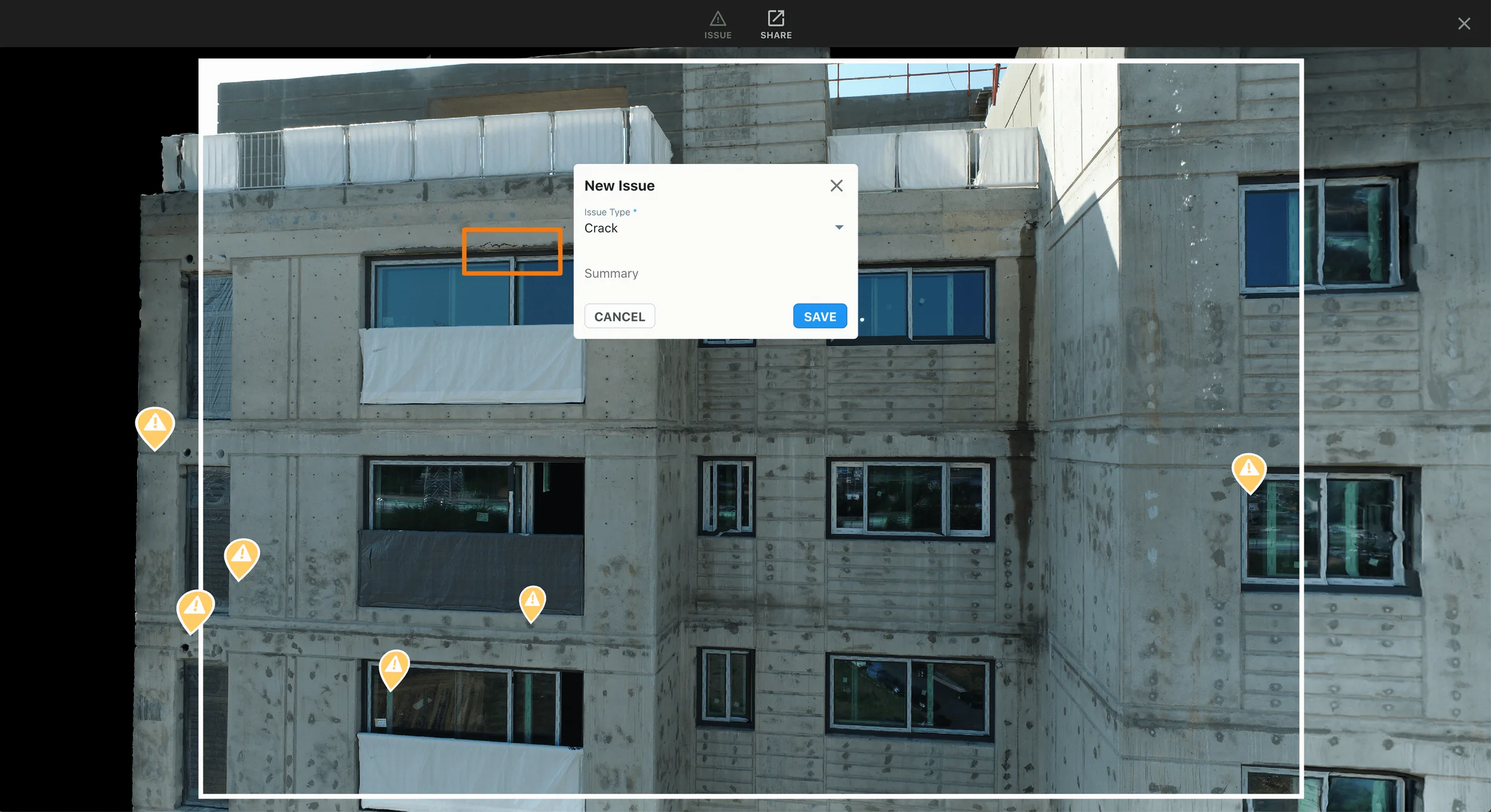
Quick Answer: AI defect detection uses machine learning models trained on tens of thousands of building images to automatically identify and classify structural defects in drone inspection imagery. The technology classifies up to 20 defect types, assigns GPS coordinates to each finding, calculates affected areas, and produces prioritized repair recommendations — all in hours instead of weeks.
How AI Defect Detection Works
The process starts with raw imagery from the drone inspection flight. A typical commercial building generates 2,000-5,000 high-resolution images. Reviewing each image manually — zooming, annotating, measuring — takes an experienced engineer 3-5 days for a single building.
AI defect detection compresses this timeline to hours. Here is the process:
- Image ingestion — All drone images are uploaded to the analysis platform with GPS metadata, camera parameters, and flight path data
- Preprocessing — Images are stitched into orthomosaics and corrected for lens distortion, lighting variations, and perspective
- Detection — Convolutional neural networks (CNNs) scan every pixel of every image, identifying regions that match trained defect patterns
- Classification — Each detected region is classified by defect type (crack, spalling, corrosion, etc.) with a confidence score
- Measurement — The system calculates the physical dimensions of each defect using image scale and GPS data
- Prioritization — Defects are ranked by severity based on type, size, location, and proximity to structural members
What AI Finds
Current AI models classify up to 20 distinct defect categories:
| Category | Defect Types | Significance |
|---|---|---|
| Structural | Cracks (structural), spalling, exposed rebar | Immediate attention — indicates active deterioration of load-bearing elements |
| Surface | Hairline cracks, staining, efflorescence, coating failure | Monitor — may indicate underlying moisture or early deterioration |
| Corrosion | Rust staining, metal corrosion, rebar exposure | High priority — progressive damage that accelerates without intervention |
| Water-Related | Water staining, biological growth, sealant failure | Address within 6 months — indicates active water pathways |
| Mechanical | Missing components, displaced elements, impact damage | Varies — assess each instance individually |
Each finding includes a GPS coordinate, photograph crop, severity rating (low/medium/high/critical), and calculated affected area in square feet.
AI vs Human Inspection
AI and human engineers are not competitors — they are complements. Each has distinct strengths:
AI excels at:
- Processing thousands of images without fatigue
- Consistent classification standards across every image
- Detecting small-scale defects (hairline cracks) that human reviewers miss due to image volume
- Calculating precise measurements (defect area, crack length) from imagery
- Comparing datasets across multiple inspections to track deterioration over time
Engineers excel at:
- Assessing structural significance (a crack near a column matters more than one in an infill panel)
- Determining root causes (is the spalling from reinforcement corrosion or freeze-thaw?)
- Recommending appropriate repair methods and priorities
- Interpreting results within the context of building age, construction type, and local conditions
- Certifying findings under professional engineering license
The combination produces better outcomes than either approach alone: AI ensures nothing is missed; the engineer ensures everything is properly interpreted.
AI vs Manual Inspection: Accuracy Comparison
| Metric | Manual Review | AI Detection | AI + Engineer Review |
|---|---|---|---|
| Defect detection rate | 60-75% | 85-95% | 95%+ |
| Processing time (2,000 images) | 3-5 days | 2-4 hours | 4-8 hours |
| Consistency across images | Varies with fatigue | 100% consistent | 100% consistent + context |
| Hairline crack detection | Often missed after image 500+ | Detected regardless of volume | Detected + significance assessed |
| False positive rate | Low (5-10%) | Moderate (10-15%) | Low (3-5% after review) |
| Area measurement accuracy | Estimated | Calculated from imagery | Verified calculations |
The key insight: AI does not replace engineers — it makes them dramatically more effective. An engineer reviewing AI-processed results spends their time on interpretation and judgment rather than the tedious work of scanning thousands of images pixel by pixel. The result is a better report, delivered faster, at lower cost.
Real-World Impact: What AI Catches That Humans Miss
In practice, the most valuable AI detections are the subtle, early-stage defects that human reviewers miss due to image volume:
- Early-stage efflorescence — Light mineral deposits indicating the beginning of moisture migration through concrete
- Hairline cracks at structural joints — Cracks under 0.5mm that indicate the onset of structural stress before visible spalling occurs
- Pattern deterioration — AI identifies that cracks on floor 7-12 follow a pattern suggesting systemic rebar corrosion, not isolated surface damage
- Sealant aging — Subtle color and texture changes in window and expansion joint sealants that indicate 1-2 years remaining before failure
- Year-over-year changes — When comparing annual surveys, AI flags areas where cracks have grown by even 1-2mm, prioritizing them for engineering review
What You Receive
A typical AI-powered inspection report includes:
- Executive summary — Building condition overview, critical findings, recommended actions
- Defect map — Annotated facade orthomosaic showing every finding with color-coded severity
- Defect inventory — Complete list with type, severity, GPS location, photo crop, and area calculation
- Prioritized action plan — Repairs ranked by urgency with cost-of-inaction estimates
- Excel export — Spreadsheet-ready data for contractor bidding and scope-of-work preparation
- PE certification — Engineer's stamp and professional sign-off on all findings
This documentation package supports SB-4D compliance, insurance claims, capital planning, and contractor procurement.
Limitations to Understand
AI defect detection is powerful but not perfect. Limitations include:
- Surface-only detection — AI analyzes surface imagery. Subsurface conditions require thermal scanning or physical testing
- Training data dependency — Models are only as good as their training data. Unusual defect patterns may be missed or misclassified
- False positives — Shadows, staining, and architectural features can occasionally trigger false defect detections. Engineer review filters these
- No structural judgment — AI identifies and classifies defects but cannot assess structural significance. That requires an engineer
These limitations reinforce why AI inspection requires professional engineering oversight. The technology accelerates and improves the data collection and analysis phases; it does not replace professional judgment.
Want to see AI defect detection in action on your building? Request a free assessment from our team.
Need a Building Inspection?
Get a free consultation and custom quote — 1-hour average response time. PE-certified reports. significantly less than scaffolding.
Frequently Asked Questions
What defects can AI detect on buildings?
AI models can classify up to 20 defect types including cracks (structural and hairline), spalling, corrosion, efflorescence, staining, sealant failure, vegetation growth, coating delamination, membrane blistering, and water damage indicators. Each defect is tagged with GPS coordinates and severity rating.
Is AI inspection more accurate than human inspection?
AI and human inspection are complementary. AI excels at consistent detection across thousands of images — it does not suffer from fatigue, attention lapses, or subjective interpretation. However, engineers provide critical context about structural significance that AI cannot assess alone.
Does AI replace the need for an engineer?
No. AI classification produces a comprehensive defect inventory, but a Professional Engineer is required to interpret the structural significance, prioritize repairs, and certify the report. AI provides the data; the engineer provides the judgment.
How fast is AI analysis compared to manual review?
AI processes thousands of images in hours, while manual image review of the same dataset would take days or weeks. For a typical 15-story building generating 2,000-5,000 images, AI analysis completes overnight and the engineer reviews results the next morning.
What format does the AI report come in?
Reports are delivered as annotated PDFs with defect maps, severity ratings, and recommended actions. Many providers also deliver Excel spreadsheets with calculated defect areas (square footage) for scope-of-work estimates and contractor bidding.