In This Guide
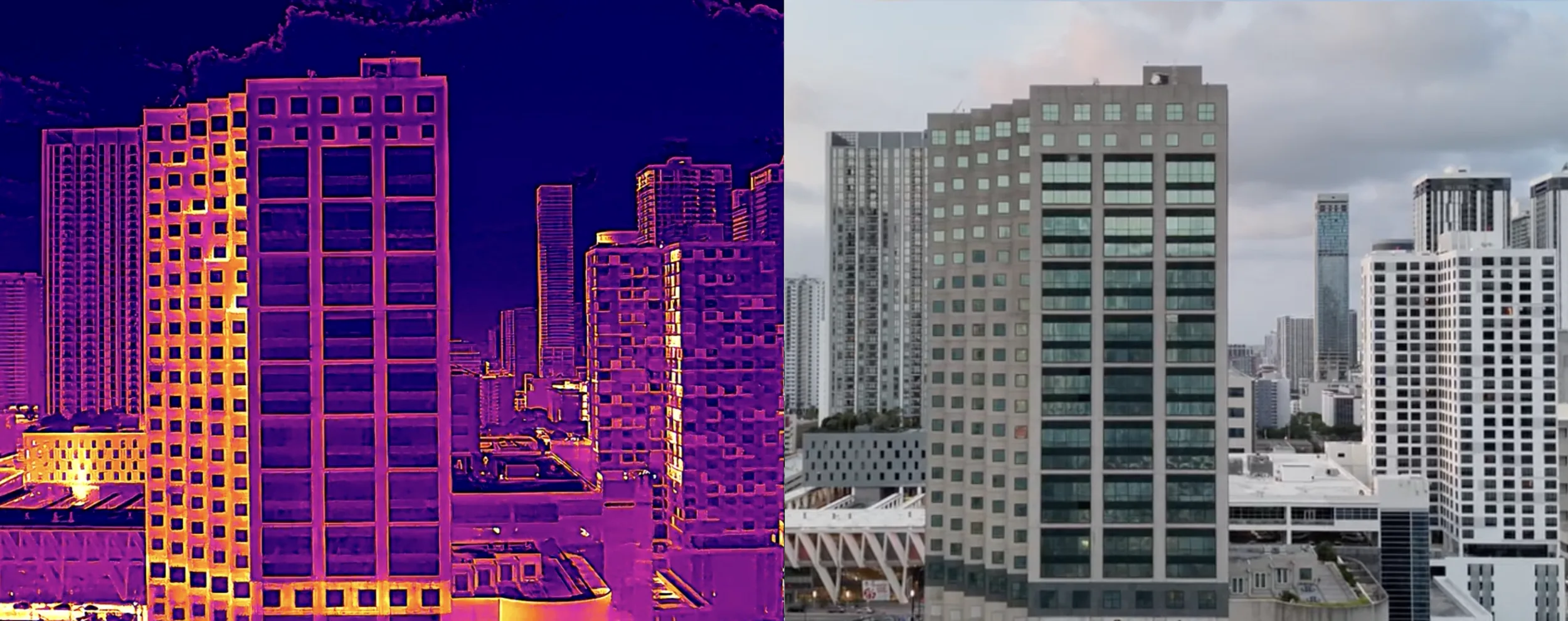
Quick Answer: A building envelope inspection evaluates the roof, exterior walls, windows, doors, and waterproofing systems that separate the building interior from the outside environment. Drone-based inspections with thermal imaging detect hidden moisture, insulation failures, and air leakage across the entire envelope — often finding problems that are invisible from ground level or even from inside the building.
What Is the Building Envelope?
The building envelope is everything that separates inside from outside. It is the roof over your head, the walls around you, the windows you look through, and every layer of material that keeps weather out and conditioned air in.
More precisely, the envelope includes:
- Roof assembly — Membrane or covering, insulation, vapor barrier, deck
- Exterior walls — Cladding (stucco, panels, masonry, curtain wall), sheathing, insulation, vapor/air barriers
- Fenestration — Windows, doors, skylights, and their frames, seals, and glazing
- Below-grade waterproofing — Foundation walls, slab-on-grade moisture barriers
- Transitions and joints — Sealants, flashing, expansion joints, penetration seals
When the envelope performs well, it controls four things: heat flow (energy efficiency), air infiltration (comfort and indoor air quality), moisture penetration (structural protection), and sound transmission (occupant comfort). When it fails, the consequences cascade through all four.
Why Envelope Inspection Matters
Moisture Is the Primary Enemy
Most building damage — mold, rot, corrosion, spalling, interior finish deterioration — traces back to moisture infiltrating the envelope. In Florida's subtropical climate, the combination of driving rain, high humidity, and intense solar heat cycling creates constant stress on every envelope component.
Water intrusion through the envelope is responsible for an estimated 70% of all construction litigation. The cost of addressing moisture problems escalates dramatically with time — a $500 sealant repair left unaddressed can become a $50,000 mold remediation project.
Energy Performance
In commercial buildings, the envelope is responsible for 25-40% of total energy consumption through heat gain/loss and air infiltration. A compromised envelope means higher utility bills, uneven temperatures, and HVAC systems working harder than necessary. In Florida, where cooling loads dominate, a well-performing envelope is critical to operational costs.
Asset Value and Compliance
Envelope condition directly impacts property value, insurance premiums, and regulatory compliance. In Florida, SB-4D milestone inspections and 40-year recertifications specifically evaluate structural envelope elements. Proactive inspection and maintenance avoids the far higher cost of emergency repairs and compliance penalties.
What Gets Inspected
| Component | What Inspectors Evaluate | Common Failure Modes |
|---|---|---|
| Roof System | Membrane condition, flashings, drainage, penetrations, ponding | Membrane splits, flashing failure, clogged drains, UV degradation |
| Exterior Walls | Cladding condition, attachment integrity, crack patterns, staining | Stucco cracking, panel displacement, concrete spalling, sealant failure |
| Windows/Doors | Seal integrity, glazing condition, frame corrosion, operation | Failed seals, fogged IGUs, frame corrosion, hardware failure |
| Sealants/Joints | Adhesion, cohesion, flexibility, coverage | Cracking, peeling, UV degradation, missed joints |
| Flashing | Material condition, terminations, laps, integration | Corrosion, displacement, improper termination, missing end dams |
| Below-Grade | Foundation waterproofing, drainage, grading | Membrane damage, negative grading, clogged drains |
Inspection Methods
Visual Assessment
The foundation of every envelope inspection. Trained inspectors examine each component for visible deficiencies — cracks, staining, displacement, deterioration, failed sealants, and other indicators. For large buildings, visual assessment is limited to ground-accessible areas without specialized access equipment.
Thermal Imaging (Infrared Thermography)
Infrared cameras detect temperature differences on building surfaces that indicate hidden problems. Wet insulation, air leaks, and moisture trapped behind cladding all create thermal signatures that are invisible to the naked eye. Thermal imaging is non-destructive, fast, and can survey large areas efficiently.
Moisture Testing
Moisture meters and probe testing quantify water content within envelope assemblies. Capacitance meters provide non-destructive surface readings, while pin-type meters provide deeper measurements at specific points. For roofing, nuclear moisture gauges can detect moisture in the roof assembly without destructive sampling.
Air Infiltration Testing
Blower-door tests (ASTM E779) pressurize or depressurize the building to measure total air leakage. Window-specific tests (ASTM E783) isolate leakage at individual fenestration units. These tests quantify the performance gap between as-built conditions and design specifications.
Water Penetration Testing
Spray rack testing (ASTM E1105) applies calibrated water pressure to wall sections to identify water entry points. This simulates wind-driven rain conditions and can isolate specific failure locations that other methods only indicate generally.
Drone and Thermal Advantages
Conventional envelope inspections face a fundamental access problem: the most vulnerable areas — roofs, upper facades, parapets, and high transitions — are the most expensive and difficult to reach. This creates a choice between incomplete inspections and expensive access equipment.
Drone-based inspection eliminates this tradeoff:
- Full coverage without scaffolding — Every square foot of roof and facade documented in a fraction of the time and cost
- Thermal survey of entire envelope — What takes a handheld thermal camera hours from scaffolding, a drone completes in minutes from the air
- AI-powered analysis — Machine learning algorithms process hundreds of images to identify defects, map moisture patterns, and quantify affected areas
- Repeatable baseline — Drone flight paths can be replicated over time, enabling precise comparison of envelope condition year-over-year
One property management group used drone-based thermal scanning to assess 53 roofs in a single night, identifying approximately 307,000 square feet of suspected moisture. That level of coverage would have taken weeks with conventional methods and cost many times more.
For commercial properties across Florida — from Miami to Tampa to Jacksonville — drone envelope inspection delivers the comprehensive data building owners need while keeping costs manageable. Request a quote for your property.
When to Schedule an Inspection
Schedule a building envelope inspection when:
- Annual maintenance cycle — At minimum, a visual walk-around of accessible areas annually
- Every 3-5 years — Comprehensive inspection with thermal imaging for buildings over 10 years old
- After severe weather — Hurricanes, hailstorms, and tropical storms can damage envelope components that appear intact from ground level
- When symptoms appear — Interior water stains, mold, musty odors, or uneven temperatures often indicate envelope failures
- Before milestone dates — Florida SB-4D milestone inspections and county recertifications require documented envelope evaluation
- Before acquisition — As part of due diligence for any commercial property purchase
The envelope is the single most important factor in long-term building performance. Proactive inspection costs a fraction of reactive repair — and protects both the physical asset and the people inside it.
Need a Building Inspection?
Get a free consultation and custom quote — 1-hour average response time. PE-certified reports. significantly less than scaffolding.
Frequently Asked Questions
What is a building envelope?
The building envelope is the physical barrier between the conditioned interior and the exterior environment. It includes the roof, exterior walls, windows, doors, foundation, and all waterproofing systems. The envelope controls heat flow, air infiltration, moisture penetration, and noise transmission.
What does a building envelope inspection include?
A thorough building envelope inspection evaluates roof condition and waterproofing, exterior wall cladding and finishes, window and door systems, sealants and flashing, foundation waterproofing, insulation performance, and air/water infiltration. Methods include visual assessment, thermal imaging, moisture testing, and air leakage testing.
How often should building envelopes be inspected?
Annual visual inspections are recommended for all commercial buildings. Comprehensive envelope inspections with thermal imaging should be performed every 3-5 years, after any severe weather event, and whenever occupants report moisture problems, drafts, or comfort issues.
How much does a building envelope inspection cost?
Costs vary significantly by building size and inspection scope. Basic visual inspections range from $1,000-$3,000. Comprehensive inspections with thermal imaging and moisture testing range from $3,000-$15,000 for mid-size commercial buildings. Drone-based inspections are typically 40-60% less expensive than scaffold-dependent methods for the same scope.
How do drones improve building envelope inspections?
Drones access roofs and upper facade areas without scaffolding or lifts, reducing cost and time. Thermal drone cameras detect hidden moisture, insulation gaps, and air leakage across the entire envelope in a single flight. AI analysis processes hundreds of images to identify defects that manual inspection might miss.