In This Guide
Quick Answer: Concrete spalling is the breaking away of concrete surfaces caused primarily by corroding reinforcement steel. In coastal Florida, salt air accelerates rebar corrosion, making spalling the leading cause of facade deterioration in high-rise buildings. Drone inspection with AI defect detection identifies spalling across entire building surfaces — including areas invisible from ground level — before it becomes a safety hazard.
What Is Concrete Spalling?
Concrete spalling is the deterioration process where pieces of concrete break away from a surface. It manifests as flaking, chipping, peeling, or — in severe cases — large sections of concrete detaching from walls, columns, beams, balconies, or parking structures.
Spalling is not merely cosmetic. It is the visible symptom of internal deterioration that, left unaddressed, progressively reduces the structural capacity of reinforced concrete elements. What starts as hairline surface cracks evolves into exposed reinforcement, section loss, and eventually structural failure.
The progression typically follows a predictable pattern:
- Initiation — Chlorides, moisture, or carbon dioxide penetrate the concrete cover
- Corrosion onset — Reinforcing steel begins to oxidize
- Expansion — Rust products occupy up to 7 times the volume of the original steel
- Cracking — Internal pressure cracks the concrete from inside out
- Delamination — Concrete separates from the reinforcement but remains loosely attached
- Spalling — Concrete pieces break free and fall
Causes of Concrete Spalling
Chloride-Induced Rebar Corrosion (Primary Cause in Florida)
Salt-laden coastal air is the dominant driver of concrete spalling in Florida. Chloride ions from sea spray penetrate concrete over time, reaching the embedded reinforcement steel. Once chloride concentration at the rebar surface exceeds a critical threshold, the steel's protective passive layer breaks down and corrosion begins.
This is why Miami Beach, Fort Lauderdale, and other coastal cities see significantly more spalling than inland areas. Buildings within 3 miles of the coast are at highest risk.
Carbonation
Atmospheric carbon dioxide slowly reacts with calcium hydroxide in concrete, reducing its alkalinity. When the carbonation front reaches the reinforcement depth, the protective environment around the steel is lost and corrosion can begin — even without chlorides present.
Inadequate Concrete Cover
Building codes specify minimum concrete cover (the distance between the outer surface and the reinforcement). When cover is insufficient — whether by design, construction error, or erosion over time — corrosion-causing agents reach the steel faster. Many buildings constructed before modern code requirements have cover depths that are inadequate for the environment.
Construction Defects
Poor concrete mix design (excessive water-to-cement ratio), inadequate curing, cold joints, and honeycombing all create pathways for moisture and chloride penetration. These defects accelerate the corrosion timeline from decades to years.
Freeze-Thaw Cycling
While less common in South Florida, buildings in Jacksonville, Tallahassee, and northern Florida experience freeze-thaw cycles. Water trapped in concrete pores expands when it freezes, creating internal pressure that breaks the concrete apart over repeated cycles.
Warning Signs to Watch For
Spalling rarely appears without warning. Earlier-stage indicators include:
- Rust staining — Brown or orange discoloration on concrete surfaces, particularly around cracks, indicates active rebar corrosion beneath
- Hairline cracks in patterns — Map cracking (random fine cracks) or linear cracks following rebar lines suggest internal expansion
- Hollow sounds — Tapping concrete with a hammer reveals delaminated areas that sound hollow compared to sound concrete
- Surface scaling — Thin layers of concrete peeling from the surface, often at slab edges
- Efflorescence — White mineral deposits on concrete surfaces indicate water migration through the material
- Exposed aggregate — Surface cement paste eroded away, revealing stones in the concrete mix
If you observe any of these signs on your building, professional inspection should not be delayed. Early detection at the delamination stage is far less expensive to address than full spalling with exposed reinforcement.
Why Spalling Is Dangerous
Concrete spalling poses three distinct categories of risk:
Falling Debris Hazard
Spalled concrete falling from upper floors of high-rise buildings can cause serious injury or death. In Florida, several incidents have prompted emergency building evacuations and sidewalk closures. Building owners can face significant liability for injuries caused by falling concrete.
Structural Capacity Reduction
As spalling progresses, the cross-sectional area of structural elements decreases. Corroded reinforcement loses tensile strength. The combination means the element can carry less load than designed. In parking garages, this has led to slab collapses. The Champlain Towers South collapse in Surfside (2021) was linked in part to long-term concrete deterioration in the pool deck and parking structure.
Accelerating Deterioration
Spalling is self-accelerating. Once concrete cover is lost, rebar corrodes faster because it is directly exposed to moisture and chlorides. This produces more rust expansion, which causes more spalling, which exposes more rebar. Without intervention, the rate of deterioration increases over time.
Detection Methods: Traditional vs. Drone
| Method | Coverage | Detects Subsurface? | Cost (20-Story Building) | Time |
|---|---|---|---|---|
| Ground-Level Visual | Lower 3-4 floors only | No | $500-$1,500 | 2-4 hours |
| Rope Access | Selected drop lines | No | $8,000-$20,000 | 3-5 days |
| Scaffolding | Full facade | No | $15,000-$50,000+ | 1-2 weeks setup |
| Drone + AI | All facades, roof | Yes (thermal) | $2,000-$5,000 | 1-2 days |
Drone facade inspection provides the most comprehensive coverage at the lowest cost. Here is how the technology detects spalling at every stage:
Visual Detection (RGB Cameras)
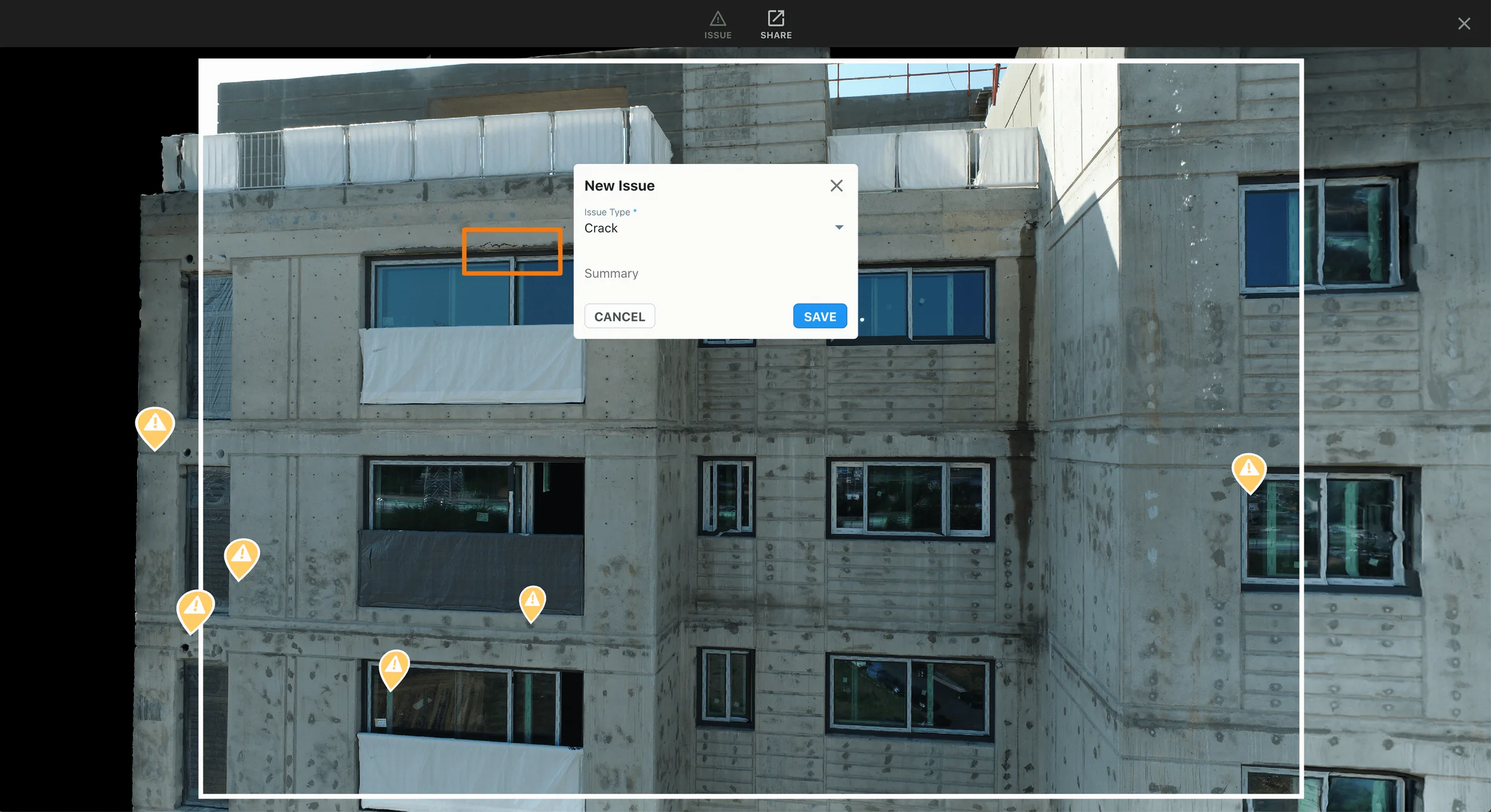
High-resolution cameras (20+ megapixels) capture every square foot of the building facade at 3 cm/pixel resolution or better. AI algorithms trained on thousands of spalling examples automatically identify and classify:
- Active spalling with exposed aggregate or rebar
- Surface scaling and flaking patterns
- Crack networks that indicate subsurface delamination
- Rust staining patterns that map corrosion locations
- Previous patch repairs that may be failing
Thermal Detection (Infrared Cameras)
Thermal imaging is the critical advantage for early detection. Delaminated concrete — where the material has separated internally but has not yet fallen — shows different thermal properties than sound concrete. During temperature transitions (early morning or evening), delaminated zones appear as thermal anomalies in infrared imagery.
This means drone thermal inspection can identify areas that will spall before they actually do — enabling preventive repair instead of emergency response.
Repair and Prevention Options
The appropriate repair depends on spalling severity:
Surface Repairs (Minor Spalling)
- Remove loose concrete to sound material
- Apply bonding agent and polymer-modified repair mortar
- Finish with protective coating or sealer to prevent future moisture and chloride ingress
- Typical cost: $15-$50 per square foot
Deep Repairs (Exposed Reinforcement)
- Remove deteriorated concrete to 1 inch behind the reinforcement
- Clean corroded rebar by sandblasting; replace bars with more than 25% section loss
- Apply corrosion inhibitor to cleaned reinforcement
- Rebuild section with structural repair mortar
- Apply protective coating system
- Typical cost: $50-$150+ per square foot
Cathodic Protection (Severe Corrosion)
For buildings with widespread corrosion, impressed-current cathodic protection (ICCP) systems can halt corrosion across the entire structure by reversing the electrochemical reaction. This is often the most cost-effective long-term solution for large buildings rather than patch-by-patch repairs.
Prevention
- Waterproof coatings — Penetrating sealers and elastomeric coatings reduce moisture and chloride ingress
- Crack sealing — Epoxy injection of cracks prevents water penetration to reinforcement
- Drainage improvements — Eliminating standing water on balconies and parking decks reduces exposure time
- Regular inspection — Catching delamination before it becomes spalling reduces repair costs by 60-80%
Florida Inspection Requirements
Following the Champlain Towers South collapse, Florida enacted SB-4D which requires milestone structural inspections for condominium and cooperative buildings three stories or taller. Buildings within 3 miles of the coast must complete their initial inspection at 25 years; all others at 30 years. Follow-up inspections are required every 10 years.
These inspections specifically focus on structural systems — exactly where spalling is most critical. Miami-Dade County and Broward County additionally require 40-year recertification inspections that predate SB-4D and remain in effect.
For any Florida building showing signs of concrete deterioration, proactive inspection is far less expensive than emergency repairs or compliance violations. Contact our team for a drone-based spalling assessment of your property.
Need a Building Inspection?
Get a free consultation and custom quote — 1-hour average response time. PE-certified reports. significantly less than scaffolding.
Frequently Asked Questions
What is concrete spalling?
Concrete spalling is the flaking, chipping, peeling, or breaking away of concrete surfaces. It occurs when internal forces — most commonly corroding reinforcement steel — push outward against the concrete cover, causing pieces to detach. Spalling ranges from cosmetic surface flaking to deep structural failures exposing rebar.
What causes concrete spalling in Florida buildings?
The primary cause in Florida is rebar corrosion driven by chloride intrusion from salt air. Coastal humidity accelerates the process. Corroding steel expands up to 7 times its original volume, cracking and displacing the surrounding concrete. Secondary causes include carbonation, freeze-thaw cycling (in North Florida), construction defects, and inadequate concrete cover over reinforcement.
Is concrete spalling dangerous?
Yes. Surface spalling on facades and balconies creates falling debris hazards for pedestrians below. Deep spalling that exposes reinforcement steel compromises structural capacity. The Champlain Towers South collapse in Surfside, FL (2021) was linked in part to long-term concrete deterioration including spalling in the pool deck and parking structure.
How do drones detect concrete spalling?
Drones capture high-resolution imagery (3 cm/pixel or better) of all building surfaces, including areas inaccessible from ground level. AI algorithms analyze these images to detect spalling patterns, exposed rebar, crack networks, rust staining, and delamination indicators. Thermal cameras can detect subsurface delamination before visible spalling occurs.
Can concrete spalling be repaired?
Yes. Repair methods depend on severity: surface spalling is addressed with patching compounds and protective coatings. Deep spalling requires removal of deteriorated concrete, rebar cleaning or replacement, application of corrosion inhibitors, and patching with polymer-modified repair mortar. Cathodic protection systems can prevent future corrosion in severe cases.
How often should buildings be inspected for spalling?
In coastal Florida, annual visual inspections and comprehensive drone inspections every 2-3 years are recommended for buildings over 15 years old. Florida SB-4D requires milestone structural inspections at 25 or 30 years (based on coastal proximity) with follow-up inspections every 10 years.