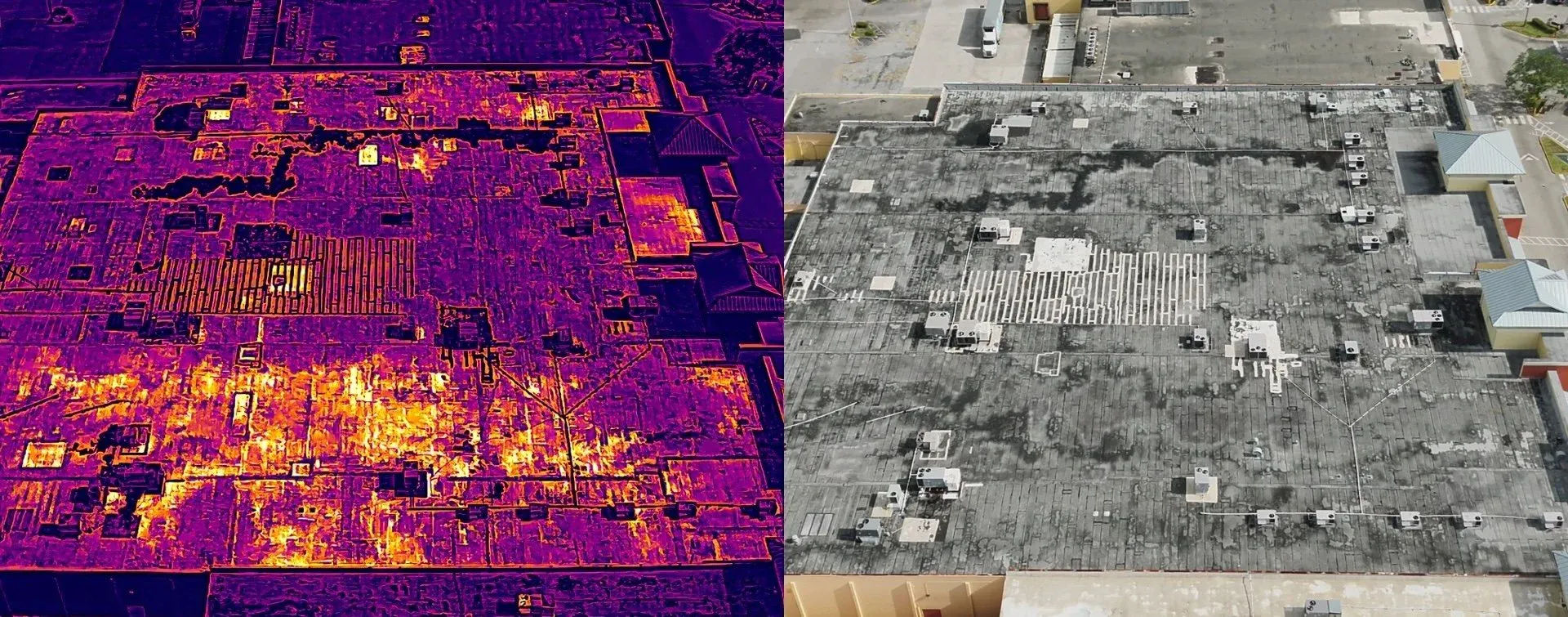
Quick Answer: A drone roof inspection uses an unmanned aerial vehicle (UAV) equipped with high-resolution cameras to capture detailed images of your roof. Costs range from $150-$500 for residential and $2,500-$8,000+ for commercial buildings. The process takes 30 minutes to 8 hours, with fast report turnaround.
What Is a Drone Roof Inspection?
A drone roof inspection replaces or supplements the traditional method of climbing onto a roof with ladders or scaffolding. An FAA-certified pilot flies a commercial drone equipped with 20-50 megapixel cameras over and around your building, capturing hundreds to thousands of overlapping images.
These images are then processed to create orthomosaics (flat, scale-accurate maps of the entire roof surface) and, in many cases, 3D models that let engineers measure distances, slopes, and defect areas without returning to the site.
For commercial and multi-story buildings, drone inspections have become the standard because they eliminate the need for expensive scaffolding setups and reduce the risk of inspector falls — the leading cause of construction-related fatalities according to OSHA data.
How the Process Works
Step 1: Pre-Flight Planning
Before the drone leaves the ground, the inspection team reviews building dimensions, FAA airspace restrictions, and weather conditions. In controlled airspace (Class B near Miami International Airport, for example), the pilot must obtain LAANC authorization through the FAA's automated system.
Step 2: Visual Capture
The drone flies a pre-programmed grid pattern at 50-100 feet above the roofline, capturing overlapping images at fixed intervals. A typical 10,000 sq ft roof generates 200-400 images. For thermal inspections, a FLIR sensor captures infrared data simultaneously, revealing moisture trapped beneath the membrane.
Step 3: AI Analysis
Images are fed through AI defect detection models that classify damage types — cracks, missing shingles, ponding water, membrane blistering, flashing failures, and biological growth. Each defect is GPS-tagged and measured.
Step 4: Professional Report
A PE-certified report documents all findings with annotated images, defect maps, severity ratings, and recommended repairs. Reports are delivered promptly after the flight.
What Drones Find on Your Roof
High-resolution drone imagery reveals problems that are difficult or impossible to spot from the ground:
- Storm damage — Missing or lifted shingles, dented metal panels, impact marks from debris
- Membrane deterioration — Cracks, blistering, and seam separation on flat commercial roofs
- Ponding water — Low spots where water collects, indicating drainage failures
- Flashing failures — Separation around vents, pipes, skylights, and parapet walls
- Biological growth — Moss, algae, and vegetation that accelerate material breakdown
- Thermal anomalies — Moisture trapped beneath the surface, insulation gaps, and air leaks visible only with infrared sensors
Cost Breakdown
| Property Type | Price Range | Includes |
|---|---|---|
| Residential (single-family) | $150 - $500 | Visual inspection, basic report, defect photos |
| Residential + Thermal | $300 - $700 | Visual + infrared scan, moisture mapping |
| Commercial (under 50,000 sq ft) | $2,500 - $5,000 | Full orthomosaic, AI analysis, PE report |
| Commercial (50,000+ sq ft) | $5,000 - $12,000 | Multi-flight capture, 3D model, thermal overlay |
Compare this to traditional scaffolding-based inspections, which run $15,000-$40,000+ for commercial buildings before you add $20,000-$50,000 in scaffolding setup costs. See our full cost guide for detailed pricing by building type.
When to Get a Drone Roof Inspection
Schedule a drone roof inspection when:
- After a major storm — Florida hurricane season (June-November) produces wind and impact damage that may not be visible from the ground. Document damage quickly for insurance claims.
- Before buying a property — A due diligence inspection reveals hidden roof conditions that affect purchase negotiations.
- Annual maintenance — Catch small problems before they become expensive repairs. A $3,000 inspection can prevent a $200,000 roof replacement.
- Compliance deadlines — Florida SB-4D milestone inspections and Miami-Dade 40-year recertification require documented structural assessments.
- Insurance renewal — Provide your insurer with current roof condition documentation to support coverage terms.
Need a quote for your building? Contact our team for a free assessment — 1-hour average response time.
Choosing the Right Provider
Not all drone inspection companies deliver the same quality. Here is what to verify before hiring:
- FAA Part 107 certification — Every commercial drone pilot must hold this federal license. Ask to see it.
- Liability insurance — $1M minimum for residential, $5M+ for commercial. Protects you if the drone causes damage.
- PE-certified reports — For compliance and insurance purposes, insist on reports signed by a licensed Professional Engineer.
- AI defect detection — Manual image review misses defects. Look for providers that use machine learning classification.
- Thermal capability — FLIR sensors detect moisture and insulation problems invisible to standard cameras.
- Local experience — Florida-specific knowledge matters: FAA airspace around MIA, FLL, TPA; hurricane damage patterns; SB-4D compliance requirements.
Learn more about our drone roof inspection service — we deploy rapidly from our Miami headquarters with FAA-certified pilots, $5M insurance, and PE-certified reports available.
Need a Building Inspection?
Get a free consultation and custom quote — 1-hour average response time. PE-certified reports. significantly less than scaffolding.
Frequently Asked Questions
How much does a drone roof inspection cost?
Residential drone roof inspections typically cost $150-$500. Commercial building inspections range from $2,500-$8,000+ depending on building size, number of stories, and whether thermal scanning is included.
Are drone roof inspections accurate?
Yes. Modern inspection drones capture 20-50MP imagery that reveals damage invisible from ground level. AI analysis can detect cracks, missing shingles, ponding water, and membrane deterioration with GPS-referenced coordinates for each defect.
How long does a drone roof inspection take?
A typical residential roof inspection takes 30-60 minutes for the flight, with a report typically delivered within a few business days. Commercial buildings take 2-8 hours depending on size and complexity.
Do I need a drone inspection or a manual inspection?
Drone inspections are preferred for steep-slope roofs, multi-story buildings, and situations where safety is a concern. Manual inspections may still be needed for hands-on membrane testing or infrared scanning at close range.
Will a drone inspection satisfy my insurance claim?
Most insurance companies accept drone inspection documentation, especially when it includes high-resolution imagery, GPS coordinates, and a professional assessment. Check with your adjuster to confirm their specific requirements.
Can drones inspect roofs in bad weather?
Drones require clear conditions — no rain, snow, or winds above 25 mph. Most operators reschedule flights if weather conditions are unsafe. In Florida, morning flights typically avoid afternoon thunderstorms.