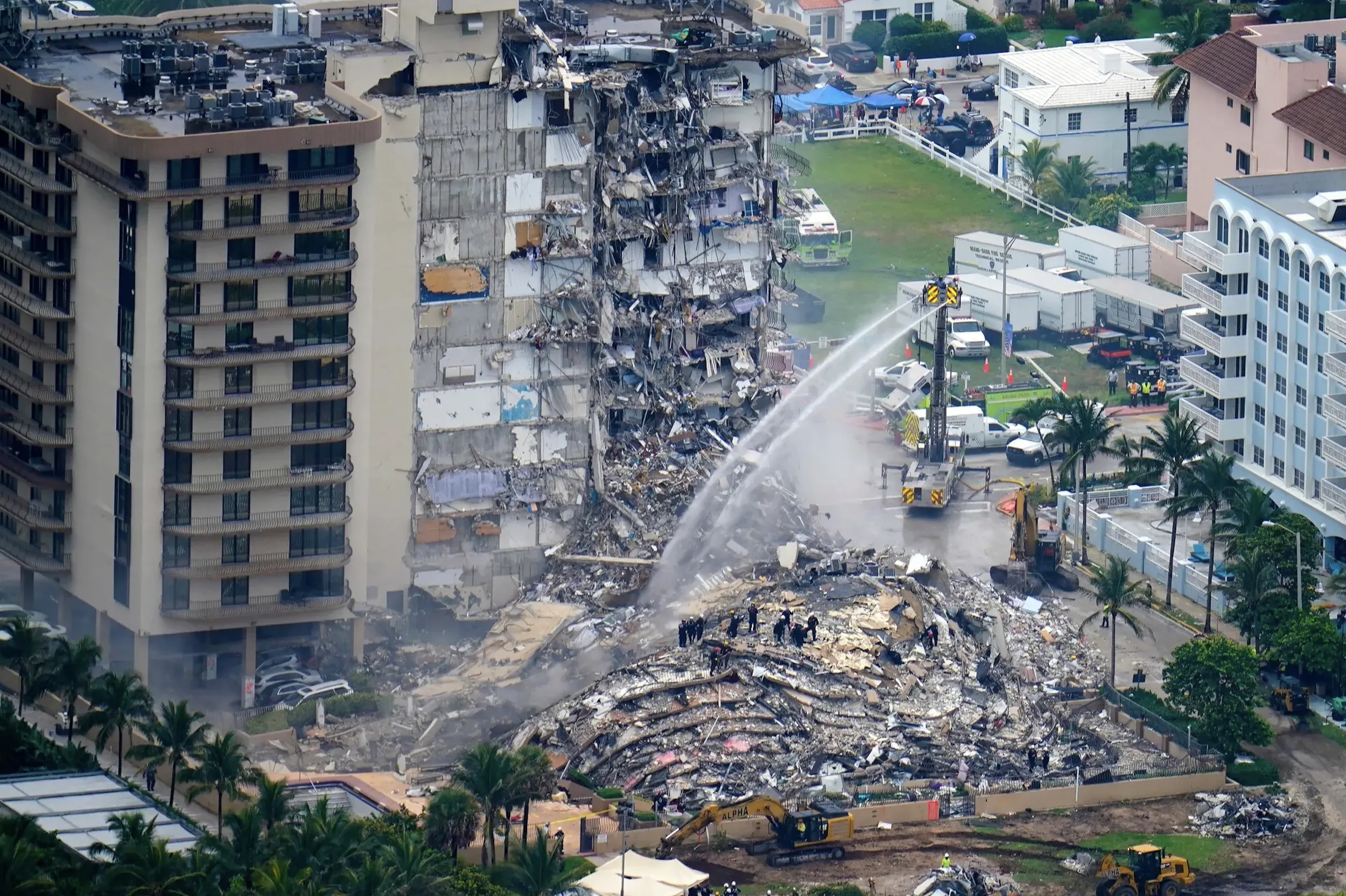
Quick Answer: The Champlain Towers South collapse in Surfside (June 24, 2021, 98 deaths) prompted Florida to enact SB-4D, requiring milestone structural inspections for condo and co-op buildings 3+ stories at 25-30 years old. The law also mandates Structural Integrity Reserve Studies (SIRS) and bans associations from waiving structural reserves.
What Happened at Surfside
On June 24, 2021, the 12-story Champlain Towers South condominium in Surfside, Florida partially collapsed, killing 98 people. It was the deadliest structural failure in United States history outside of deliberate demolition or natural disaster.
Investigations revealed that the building had known structural issues — documented in a 2018 engineering report — that were not adequately addressed. The pool deck showed evidence of progressive deterioration, reinforcement corrosion, and waterproofing failures. The association had deferred repairs and underfunded reserves for years.
The tragedy exposed critical gaps in Florida's building safety framework: no statewide inspection requirement existed for aging buildings. Only Miami-Dade and Broward counties had their own 40-year recertification programs.
What Changed in Florida Law
Florida responded with three pieces of legislation:
SB-4D (2022) — The Foundation
- Created statewide milestone inspection requirements for condo/co-op buildings 3+ stories
- Set inspection triggers at 25 years (coastal) and 30 years (standard) from Certificate of Occupancy
- Required Structural Integrity Reserve Studies (SIRS)
- Banned associations from waiving or reducing structural reserves
SB 154 (2023) — Adjustments
- Shifted the default inspection trigger to 30 years statewide
- Allowed local governments to maintain 25-year requirements in coastal areas
- Provided deadline extensions for buildings with inspections already in progress
HB 913 (2024) — Refinements
- Clarified the definition of "habitable stories" for the height threshold
- Addressed additional financial reporting requirements for associations
For a detailed breakdown of the current requirements, see our complete SB-4D guide and our comprehensive Florida building inspection requirements guide.
Legislative Timeline
| Date | Event | Impact |
|---|---|---|
| June 24, 2021 | Champlain Towers South collapse | 98 deaths, exposed gaps in FL building safety framework |
| May 2022 | SB-4D signed into law | Statewide milestone inspections + SIRS created |
| 2023 | SB 154 passed | Default trigger shifted to 30 years, deadline extensions |
| 2024 | HB 913 passed | Clarified "habitable stories," financial reporting rules |
| Dec 31, 2024 | First milestone deadline | Buildings with CO before July 1, 1992 |
| Jan 1, 2025 | Reserve funding mandate | No more waiving structural reserves |
| Dec 31, 2025 | SIRS + second milestone deadline | Most associations must have SIRS complete |
Who Is Affected
The post-Surfside requirements affect thousands of buildings across Florida:
- Condominium associations — Any condo building 3+ habitable stories and 25-30+ years old
- Cooperative housing — Same criteria as condominiums
- Condo boards and directors — Personal liability for compliance failures
- Unit owners — Responsible for funding inspections and reserves through assessments
- Buyers and lenders — Compliance status affects transactions and financing
The impact is concentrated in South Florida, where thousands of coastal condominiums built during the 1970s-1990s construction boom are now reaching their milestone inspection deadlines. Cities like Miami Beach, Fort Lauderdale, Hollywood, and Boca Raton have large inventories of aging condo buildings.
What Condo Boards Must Do
- Determine your deadline — Find your Certificate of Occupancy date and calculate whether you are within the 25 or 30-year threshold. Check with your local building department for jurisdiction-specific requirements.
- Hire a qualified inspector — Engage a Florida-licensed PE or Registered Architect to conduct the Phase 1 milestone inspection. Start 6-12 months before your deadline.
- Complete the SIRS — Commission a Structural Integrity Reserve Study covering all required components (roof, walls, foundation, floor systems, plumbing, electrical, waterproofing, windows, fire protection).
- Fund reserves adequately — Adjust association budgets and assessments based on SIRS findings. Waiver of structural reserves is no longer permitted.
- File reports — Submit inspection reports to the local building official, retain for 15 years, and make available to owners and prospective buyers.
Financial Impact on Associations
The post-Surfside requirements carry significant financial implications for associations:
- Inspection costs — $4,000-$12,000 with drone methods; $15,000-$40,000+ with traditional scaffolding (see our cost guide)
- Reserve funding increases — Many associations that previously waived reserves now face large reserve obligations, sometimes requiring special assessments of $50,000-$100,000+ per unit
- Repair costs — Buildings found to have structural deterioration face remediation costs that can reach millions of dollars
For many associations, the question is not whether to invest in inspections and maintenance — it is how to do so efficiently. This is where drone inspection provides its greatest value: the same PE-certified assessment at 60-80% lower cost than traditional methods.
How Modern Technology Addresses Surfside-Era Failures
The Surfside investigation revealed that traditional inspection methods failed to detect the progressive deterioration that led to the collapse. Modern drone and AI technology addresses these exact failures:
- Complete coverage vs spot checks — Drone inspections photograph 90-100% of building surfaces, eliminating the blind spots that allowed Surfside's deterioration to go undocumented
- Thermal imaging reveals moisture migration and waterproofing failures beneath the surface — the exact type of hidden deterioration present at Champlain Towers
- AI defect detection systematically classifies every crack, spall, and anomaly, preventing the subjective inconsistency that allowed known problems to be minimized in reports
- Year-over-year tracking — GPS-referenced imagery enables automated comparison between annual surveys, revealing deterioration rates objectively
For associations serious about preventing another Surfside, the question is not whether to inspect — it is whether to use inspection methods comprehensive enough to actually find problems before they become catastrophic.
A Proactive Approach
Rather than waiting for compliance deadlines, proactive condo boards are adopting preventative maintenance inspection programs that:
- Inspect the building annually or bi-annually with drone and thermal scanning
- Track deterioration trends over time with consistent digital documentation
- Catch problems when they cost hundreds — not when they cost hundreds of thousands
- Demonstrate responsible governance to unit owners, insurers, and buyers
- Build a documented maintenance history that supports property values
If your condo association is planning its milestone inspection or considering a preventative maintenance program, contact our team for a free assessment. We work with dozens of condo associations across South Florida.
Need a Building Inspection?
Get a free consultation and custom quote — 1-hour average response time. PE-certified reports. significantly less than scaffolding.
Frequently Asked Questions
What changed after the Surfside collapse?
Florida enacted SB-4D in 2022, creating statewide milestone inspection requirements for condo and co-op buildings 3+ stories. Previously, only Miami-Dade and Broward counties had mandatory inspection programs. The law also required Structural Integrity Reserve Studies (SIRS) and banned associations from waiving structural reserves.
Does my condo need an inspection now?
If your building is a condominium or cooperative, is 3+ habitable stories, and is 25-30+ years old, it likely requires a milestone inspection under SB-4D. Contact your local building department to confirm your specific deadline.
Who pays for the inspection?
The condominium association is responsible for inspection costs, funded through association reserves or special assessments. SB-4D also requires associations to maintain adequate reserves for structural components, which cannot be waived by owner vote.
Can our board be held personally liable?
Yes. Board directors who fail to comply with SB-4D inspection requirements may face personal liability. The law places affirmative obligations on associations and their boards to conduct inspections and maintain reserves.
What is the SIRS requirement?
A Structural Integrity Reserve Study (SIRS) evaluates the remaining useful life and replacement cost of major structural components (roof, load-bearing walls, foundation, floor systems, plumbing, electrical, waterproofing, windows, fire protection). Associations must fund reserves based on SIRS findings and can no longer vote to waive or reduce structural reserves.
How much do post-Surfside inspections cost?
Milestone Phase 1 inspections cost $5,000-$15,000 depending on building size. Phase 2 (if triggered) costs $15,000-$50,000+. SIRS costs $5,000-$35,000. Drone inspections for the visual assessment component cost $3,000-$12,000, providing 90-100% coverage at lower cost than traditional scaffolding methods.
What technology helps with post-Surfside compliance?
Drone inspections with AI defect detection and thermal imaging provide the most comprehensive visual assessment data for milestone inspections. Drones cover 90-100% of building facades versus 10-15% with ground-level inspection, detecting hidden issues like moisture intrusion and subsurface delamination that led to the Surfside failure.