In This Guide
Quick Answer: Drone storm damage assessments are 5-7x faster than traditional manual inspections, document every square foot of the roof in high resolution, and produce the timestamped evidence needed to support insurance claims. Most assessments are completed within 24-72 hours of safe flying conditions.
Why Speed Matters After a Storm
When a hurricane, hailstorm, or severe weather event damages a building, the clock starts ticking on multiple fronts:
- Insurance reporting deadlines — Most policies require damage notification within 30-60 days. Some carriers impose even shorter windows for filing documented claims.
- Secondary damage prevention — A compromised roof allows water intrusion with every subsequent rain event, turning a roof repair into an interior renovation.
- Tenant and occupant safety — Structural damage may not be visible from inside the building but can pose collapse or fall-through risks.
- Contractor availability — After major storms, qualified roofing contractors are booked weeks out. Earlier assessment means earlier placement in the repair queue.
The problem: traditional inspection methods are too slow. Sending crews onto damaged roofs is dangerous, scaffolding takes days to erect, and demand for inspectors spikes after every major weather event. The result is a bottleneck that delays both claims and repairs.
The Drone Assessment Advantage
Drone-based storm damage assessment eliminates the speed bottleneck. The numbers speak clearly:
| Metric | Traditional Assessment | Drone Assessment |
|---|---|---|
| Time per building | 2-4 hours | 10-30 minutes |
| Roof coverage | Accessible areas only | 100% of roof surface |
| Safety risk | High (damaged surfaces) | None (remote operation) |
| Image resolution | Handheld camera photos | 3 cm/pixel systematic capture |
| Report turnaround | 5-10 business days | Days, not weeks |
During Hurricane Helene response operations, drone teams covered over 100 miles and identified more than 1,400 damage spots in a single month — work that would have taken traditional crews several months to complete. That kind of throughput transforms disaster response from reactive to proactive.
Types of Storm Damage Drones Detect
High-resolution drone imagery and AI-powered analysis identify the full spectrum of storm damage:
Wind Damage
- Missing, lifted, or creased shingles
- Torn or displaced membrane sections on flat roofs
- Lifted flashing at edges, penetrations, and transitions
- Displaced ridge caps and vent covers
- Structural displacement of roof deck components
Hail Damage
- Impact marks on shingles, metal panels, and membrane
- Granule loss patterns on asphalt shingles
- Dents and dimples on metal roofing and flashing
- Cracked or shattered skylights and roof-mounted equipment
Water and Debris Damage
- Ponding water indicating drainage failures
- Debris impact zones from fallen trees or airborne objects
- Clogged or displaced gutters and downspouts
- Satellite dish and equipment displacement
Hidden Damage (Thermal Detection)
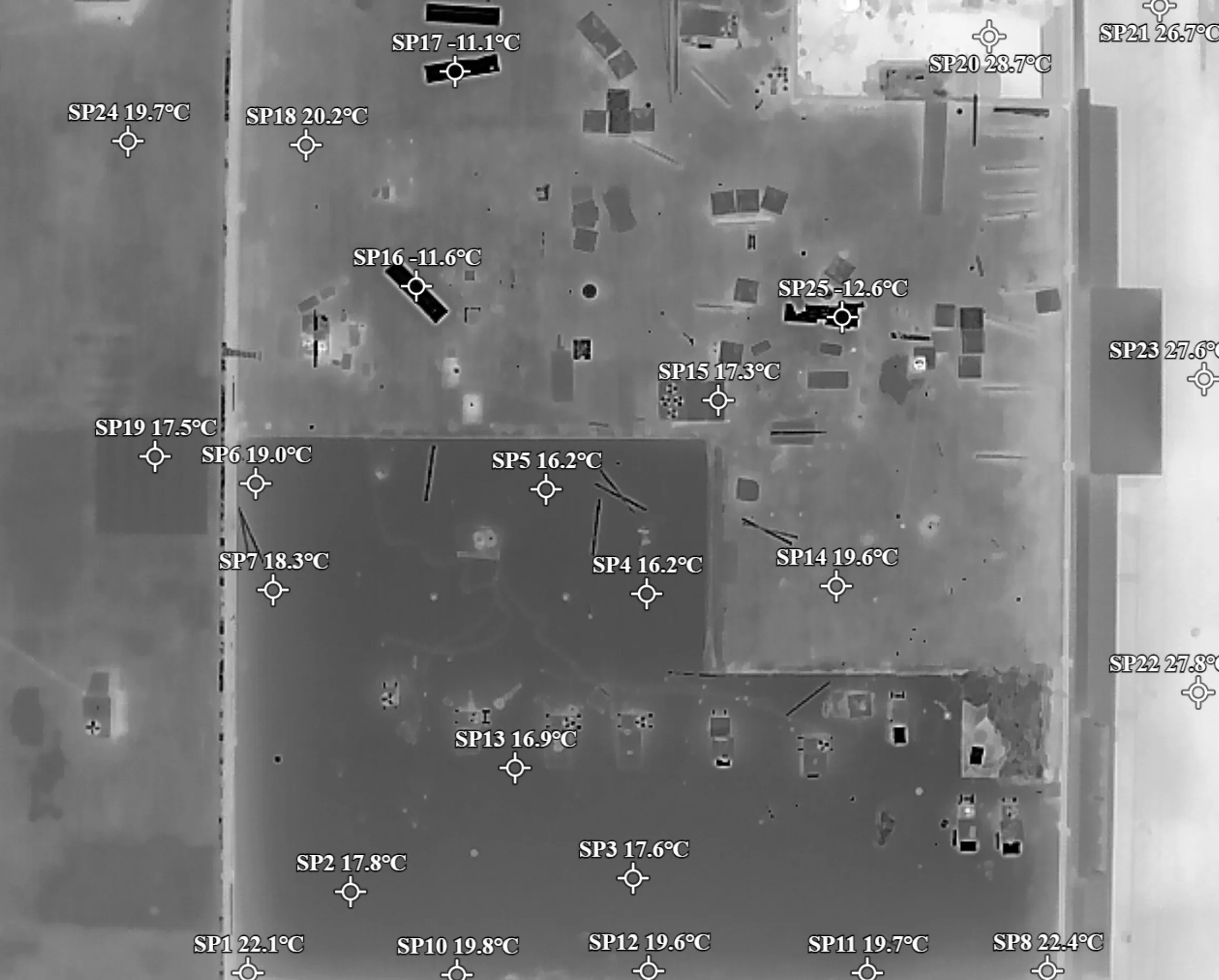
Thermal drone cameras reveal damage invisible to standard photography — trapped moisture beneath roofing membranes, saturated insulation, and active water intrusion paths. These hidden issues often represent the most expensive repairs and are the most commonly missed in visual-only assessments.
Strengthening Insurance Claims
Insurance claims live or die on documentation quality. The most common reasons claims are denied or underpaid:
- Insufficient evidence of damage scope
- Inability to distinguish storm damage from pre-existing wear
- Incomplete coverage — only documenting the obvious damage
- Delayed reporting that allows secondary deterioration
Drone assessments address every one of these weaknesses. Each image is timestamped and geo-tagged, creating an irrefutable record of conditions at a specific date. AI analysis can count individual hail impacts — in one documented case following Hurricane Nicole, an AI-assisted drone inspection identified 240 impact marks that a manual inspection had missed, resulting in full claim approval after an initial denial.
The key elements that make drone documentation compelling for insurers:
- Complete coverage — Every square foot documented, not just the areas an inspector could safely reach
- Measurable quantities — AI calculates affected square footage, number of impact points, and linear feet of damaged flashing
- Before/after comparison — For properties with prior drone surveys, side-by-side comparison isolates storm-specific damage from pre-existing conditions
- PE certification — Engineer-stamped reports carry professional liability weight that general contractor assessments do not
For more on how drone documentation supports the claims process, see our guide to drone inspection for insurance claims.
The Assessment Process
Here is what to expect when you schedule a post-storm drone assessment:
1. Initial Contact (Day 0)
Contact us as soon as the storm passes. We monitor weather conditions and FAA temporary flight restrictions to determine the earliest safe deployment window. For Florida properties, we can typically deploy within 24-48 hours of storm clearance.
2. Flight Operations (Day 1-2)
Our FAA Part 107 certified pilots fly systematic grid patterns over the roof at multiple altitudes. Standard RGB cameras capture structural damage while thermal cameras map moisture intrusion. A typical commercial building takes 15-30 minutes of flight time.
3. AI Analysis and Report (Day 2-3)
AI algorithms process hundreds to thousands of images, flagging and classifying every detected anomaly. A structural engineer reviews the findings, adds professional context, and produces the PE-certified report.
4. Deliverables
You receive a comprehensive damage report with annotated imagery, thermal overlays, a defect map showing damage locations and severity, quantified damage metrics, and repair recommendations — everything your insurance adjuster needs to process the claim.
Need rapid post-storm documentation? Contact our team for priority deployment from our Miami or Fort Lauderdale offices.
What to Look for in a Provider
Not all post-storm inspection providers offer the same value. Prioritize these capabilities:
- Rapid deployment — Can they be on-site within 48 hours of safe conditions?
- Insurance-grade documentation — Timestamped, geo-tagged imagery with PE-certified reports
- Thermal capability — RGB-only inspections miss hidden moisture damage
- AI analysis — Automated defect detection ensures nothing is overlooked in hundreds of images
- FAA compliance — Part 107 certification and $5M+ liability insurance are non-negotiable for commercial operations
- Florida experience — Understanding of local building codes, insurance requirements, and hurricane-specific damage patterns
Storm damage assessment is a race against time and secondary deterioration. Drone technology turns what used to take weeks into days — protecting your property and your claim.
Need a Building Inspection?
Get a free consultation and custom quote — 1-hour average response time. PE-certified reports. significantly less than scaffolding.
Frequently Asked Questions
How soon after a storm should I get a roof inspection?
As soon as it is safe to fly — typically 24-72 hours after the storm passes. Prompt inspection is critical because many insurance policies have reporting deadlines (often 30-60 days), and additional rain can worsen damage if tarping or temporary repairs are delayed.
Can drones fly in post-storm conditions?
Drones require wind speeds below 25-30 mph and no active precipitation. After most storms, safe flying conditions return within 24-48 hours. FAA may issue temporary flight restrictions (TFRs) in disaster zones, but commercial drone operators with proper waivers can typically operate once conditions stabilize.
How do drone inspections help with insurance claims?
Drone inspections produce timestamped, geo-tagged, high-resolution imagery that documents every square foot of the roof. AI analysis can identify and quantify damage (number of impact marks, square footage of missing material). This objective evidence makes it difficult for insurers to dispute the scope of damage.
What types of storm damage can drones detect?
Drones detect missing shingles, lifted or creased shingles, hail impact marks, punctures, torn membrane sections, displaced flashing, clogged or damaged gutters, debris impact damage, and water ponding. Thermal cameras can also reveal hidden moisture beneath roofing materials.
How much does a drone storm damage assessment cost?
Post-storm drone roof assessments typically range from $300-$800 for residential properties and $800-$3,000+ for commercial buildings, depending on roof size and report complexity. This is significantly less than scaffolding-based assessments and the cost is often recoverable through the insurance claim.