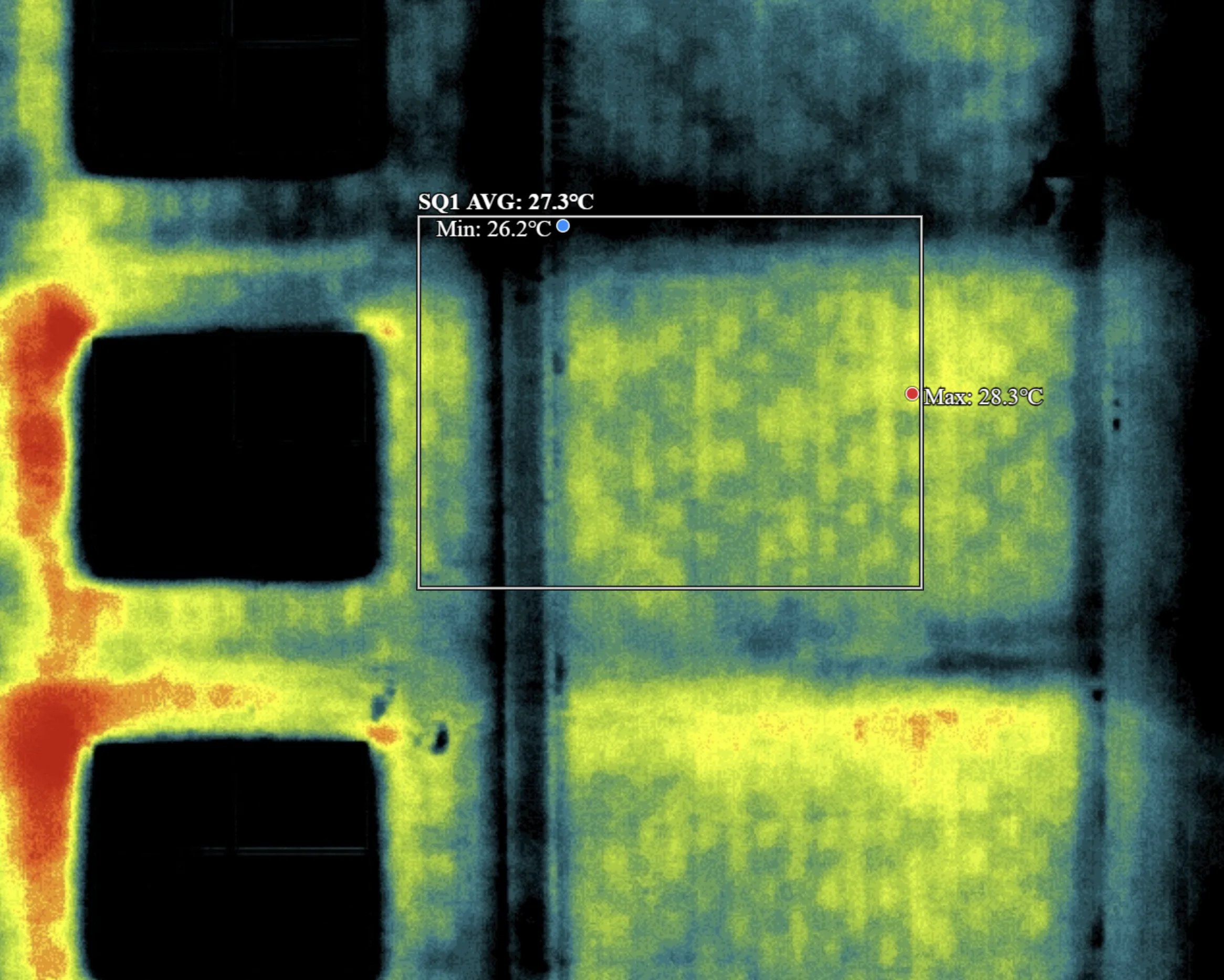
Quick Answer: Thermal drone inspection uses FLIR infrared sensors to detect building problems invisible to standard cameras — moisture intrusion, insulation failure, air leaks, and structural separation. A thermal scan covers 100% of the building facade in hours, identifying issues that traditional tap-testing catches on only 10-15% of the surface.
What Thermal Inspection Finds
Standard visual inspection captures what you can see: cracks, staining, spalling, vegetation growth. Thermal inspection captures what you cannot see — conditions hidden behind the building's exterior surface.
Moisture Intrusion
Water trapped behind stucco, EIFS, or concrete facades creates a distinct thermal signature. Moisture-laden areas cool faster through evaporation, appearing as dark (cooler) zones on infrared imagery. This is the most valuable finding in thermal inspection because hidden moisture causes:
- Reinforcement corrosion leading to concrete spalling
- Mold growth inside wall cavities
- Structural separation between facade layers
- Paint and coating failure
Insulation Gaps
Missing or compressed insulation allows heat transfer through the building envelope. On infrared imagery, these gaps appear as hot spots (in cooling season) or cold spots (in heating season). Identifying and sealing insulation gaps can reduce energy costs.
Air Leaks
Thermal scanning reveals air infiltration around windows, doors, expansion joints, and penetrations. These leaks waste energy and allow moisture to enter the building assembly.
Structural Separation
When facade cladding separates from the substrate, the air gap creates a thermal boundary visible on infrared. This is particularly important for stucco and EIFS buildings where visual inspection cannot detect delamination without destructive testing.
How Thermal Drone Scanning Works
The inspection drone carries two sensors simultaneously:
- Visual camera (20-50MP) — Captures standard high-resolution imagery for crack detection, staining, and surface defect analysis
- FLIR thermal sensor — Captures infrared radiation emitted by building surfaces, producing a temperature map of the entire facade
Both datasets are GPS-tagged and time-stamped, allowing engineers to overlay thermal anomalies on visual imagery. This produces a precise map showing exactly where hidden problems are located — down to the specific floor, unit, and wall section.
The drone flies the same grid pattern as a standard facade inspection, capturing thermal data at every position. Processing combines the thermal and visual datasets into a unified assessment.
Thermal vs Visual-Only Inspection
| Capability | Visual Only | Visual + Thermal |
|---|---|---|
| Surface cracks | Yes | Yes |
| Spalling and corrosion | Yes | Yes |
| Staining and efflorescence | Yes | Yes |
| Hidden moisture | No | Yes |
| Insulation defects | No | Yes |
| Air leaks | No | Yes |
| Delamination behind cladding | No | Yes |
| Electrical hotspots | No | Yes |
A visual-only inspection misses the four most expensive categories of building defects. For any building where moisture exposure is a concern — which includes virtually every building in coastal Florida — thermal scanning should be considered essential, not optional.
Best Conditions for Thermal Scanning
Thermal imaging requires adequate temperature differentials between the building interior and exterior. The best results occur when:
- Temperature differential is 10°F+ between inside and outside the building
- No recent rain — wet surfaces produce misleading thermal signatures (wait 24-48 hours after rain)
- Early morning or late afternoon — sun-heated facades create strong differentials for detecting moisture cooling patterns
- Wind speed below 15 mph — wind convection reduces surface temperature differentials
- Cloud cover preferred — direct sunlight creates thermal reflections that can mask anomalies
In Florida, the best thermal scanning season is October through April when morning temperatures are lower and buildings run HVAC systems that create temperature differentials.
When to Add Thermal to Your Inspection
Not every inspection requires thermal scanning. Here is when it adds the most value:
| Scenario | Thermal Recommended? | Why |
|---|---|---|
| Building over 10 years old | Yes | Waterproofing and sealants begin deteriorating |
| Coastal Florida location | Yes | Salt air accelerates envelope deterioration and moisture intrusion |
| Post-hurricane assessment | Yes | Wind-driven rain creates hidden moisture behind intact surfaces |
| SB-4D milestone inspection | Yes | More thorough Phase 1 data reduces Phase 2 risk |
| HVAC efficiency concerns | Yes | Identifies insulation gaps and air leaks driving energy waste |
| New construction (under 5 years) | Optional | Lower risk, but useful for warranty documentation |
| Routine annual monitoring | Every 2-3 years | Alternating visual-only and thermal+visual keeps costs manageable |
What Thermal Finds That Visual Misses
Here are five categories of problems that thermal inspection routinely discovers in Florida buildings:
- Hidden moisture behind stucco — Stucco facades can absorb and trap water for months. Thermal imaging reveals the moisture pattern, identifying failed sealants or cracks before spalling begins.
- Roof membrane saturation — Flat commercial roofs with saturated insulation appear cooler at night as trapped moisture evaporates. Thermal scans map exactly which sections need replacement versus overlay.
- Balcony waterproofing failure — Florida balcony inspections benefit enormously from thermal data. Failed waterproofing membranes show as distinct thermal zones before water reaches the slab reinforcement.
- Window and door air leaks — Infrared reveals temperature differentials around window frames, indicating failed gaskets or missing sealant strips that waste HVAC energy.
- Electrical hotspots — Overloaded circuits, loose connections, and deteriorating electrical components generate excess heat visible on thermal cameras — a fire prevention tool.
Cost and ROI
Adding thermal scanning to a facade or roof inspection typically adds $1,000-$3,000 to the base price. For the full pricing breakdown, see our drone inspection cost guide.
The return on that investment is substantial. A single hidden moisture intrusion left undetected for 2-3 years can cause:
- Concrete spalling repair: $50,000 - $200,000
- Mold remediation: $10,000 - $100,000
- Interior finish damage: $5,000 - $50,000 per affected unit
- Insurance claim complications: difficult to quantify
A thermal add-on that prevents even one of these scenarios can pay for itself many times over.
Ready to see what is hiding behind your building's facade? Request a free thermal inspection assessment from our team.
Need a Building Inspection?
Get a free consultation and custom quote — 1-hour average response time. PE-certified reports. significantly less than scaffolding.
Frequently Asked Questions
What can thermal imaging detect on a building?
Thermal imaging detects moisture trapped behind walls and roofing membranes, insulation gaps, air leaks around windows and doors, HVAC system leaks, electrical hotspots, and areas of structural separation where temperature differentials indicate hidden problems.
How does thermal drone scanning work?
A FLIR infrared sensor mounted on the drone captures surface temperature data across the building. Moisture-laden areas appear cooler (due to evaporative cooling), while insulation gaps appear warmer (heat escaping). The data is overlaid on visual imagery to pinpoint exact defect locations.
When is the best time for a thermal inspection?
Early morning or evening provides the best temperature differentials. The building should have been heated or cooled by the sun for several hours before scanning. Avoid scanning during or immediately after rain, as wet surfaces produce misleading readings.
Is thermal inspection worth the extra cost?
Yes. Thermal scanning adds $1,000-$3,000 to a standard inspection but frequently reveals hidden moisture problems worth $50,000-$200,000+ in prevented damage. For any building over 10 years old, thermal should be standard.
Can thermal imaging see through walls?
Thermal cameras do not see through walls. They detect surface temperature variations caused by conditions behind the surface — such as moisture, missing insulation, or air leaks. The camera reads heat signatures, not structural content.