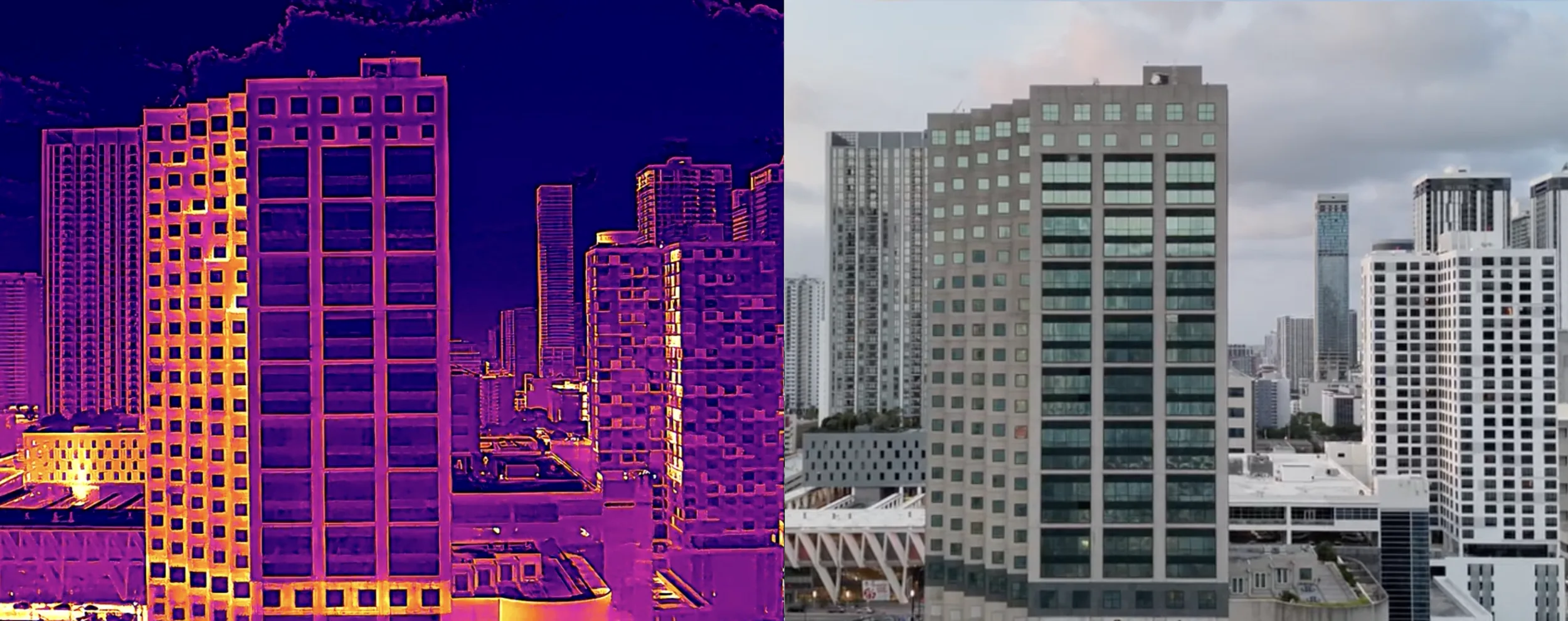
Key Fact: Water intrusion is responsible for more building envelope failures than any other single cause. According to industry data, moisture-related problems account for over 70% of all building envelope warranty claims and litigation. Early detection through thermal imaging can reduce remediation costs by 60-80%.
What Is Water Intrusion?
Water intrusion is the uncontrolled entry of water into a building through its envelope — the system of roofing, walls, windows, doors, foundations, and joints that separates the interior environment from the exterior. It is distinct from plumbing leaks (internal water system failures) and condensation (moisture from indoor humidity), though all three produce similar damage.
Water intrusion ranges from obvious (visible dripping during rain) to insidious (slow moisture migration through porous materials that causes damage over months or years without visible signs). The insidious type is far more costly because it often goes undetected until structural damage, mold growth, or system failures become severe.
Common Sources of Water Intrusion
| Source | Entry Point | How It Happens | Frequency |
|---|---|---|---|
| Roof | Membrane, flashing, drains, penetrations | Membrane aging, ponding water, punctures, clogged drains | Very common |
| Windows and doors | Perimeter sealant, flashing, weep holes | Failed sealant, missing flashing, blocked weep holes | Very common |
| Exterior walls | Cracks, joints, porous materials | Wind-driven rain through cracks, mortar joint failure | Common |
| Below grade | Foundation walls, slab joints | Hydrostatic pressure, rising groundwater, poor drainage | Common |
| Balconies and decks | Waterproofing membrane, railing connections | Membrane failure, inadequate slope, penetration leaks | Common in FL |
| HVAC systems | Condensate lines, duct penetrations | Clogged drain lines, duct sweating, improper sealing | Moderate |
In Florida, the combination of heavy rainfall, hurricanes, high humidity, and salt air makes water intrusion particularly aggressive. The building envelope must withstand driving rain at 100+ mph during hurricane season.
How to Recognize the Signs
Water intrusion often reveals itself through indirect signs before visible leaking occurs:
- Staining — Brown or yellow water stains on ceilings, walls, or around windows
- Paint and finish failure — Peeling paint, bubbling wallpaper, or discolored patches
- Odor — Musty or earthy smell indicating mold growth behind surfaces
- Efflorescence — White salt deposits on concrete or masonry (water has carried salts to the surface)
- Material swelling — Warped wood, swollen drywall, buckled flooring
- Mold growth — Visible mold on surfaces or in hidden cavities
- Elevated humidity — Specific rooms or floors registering higher humidity than normal
- Rust staining — On concrete surfaces, indicates water has reached reinforcing steel
Detection Methods Compared
| Method | Best For | Limitations | Cost |
|---|---|---|---|
| Infrared thermography | Large-area screening, hidden moisture | Requires temperature differential | $2,000 - $8,000 |
| Moisture meters | Confirming suspected wet areas | Point measurements only, surface access needed | $200 - $1,000 per area |
| Spray rack testing | Window and curtain wall testing | Time-consuming, one section at a time | $500 - $2,000 per window |
| Borescope camera | Viewing inside wall cavities | Requires drilling access holes | $300 - $800 per location |
| Capacitance scanning | Non-destructive roof surveys | Roof access required | $3,000 - $10,000 |
| Visual inspection | Obvious damage and staining | Cannot detect hidden moisture | Included in standard inspection |
How Thermal Imaging Finds Hidden Moisture
Infrared thermal imaging is the gold standard for non-invasive water intrusion detection because moisture changes the thermal properties of building materials in predictable ways:
- Evaporative cooling — wet materials appear cooler than surrounding dry materials on thermal images due to evaporation
- Thermal mass differences — water-saturated materials retain and conduct heat differently, creating visible thermal contrast
- Pattern recognition — the shape and location of thermal anomalies reveal the intrusion source (linear pattern at a joint = sealant failure; circular pattern = pipe leak; triangular from a corner = flashing failure)
Drone-mounted thermal cameras are particularly effective because they can scan the entire building exterior — every floor, every elevation — in a single flight, identifying intrusion points that are invisible from ground level.
The True Cost of Water Intrusion
| Damage Type | Repair Cost Range | If Caught Early | If Deferred 3-5 Years |
|---|---|---|---|
| Sealant/caulk repair | $500 - $2,000 | $500 | $5,000+ (water has entered) |
| Window flashing | $2,000 - $5,000/window | $2,000 | $10,000+ (mold behind wall) |
| Roof membrane repair | $5,000 - $15,000 | $5,000 | $50,000+ (insulation + deck damage) |
| Mold remediation | $10,000 - $100,000+ | Preventable | $50,000+ avg for commercial |
| Structural repair (corrosion) | $50,000 - $500,000+ | Preventable | $200,000+ (steel/concrete repair) |
The pattern is consistent: early detection significantly reduces repair costs. A $3,000 thermal scan that finds a $500 sealant failure prevents a $50,000 mold remediation.
Prevention Strategies
- Regular envelope inspections — Annual drone inspections with thermal imaging catch problems before they cause damage
- Sealant maintenance — Replace exterior sealants every 7-10 years, or sooner if inspection reveals deterioration
- Roof maintenance — Clear drains quarterly, inspect membrane annually, repair punctures immediately
- Positive drainage — Ensure all surfaces slope away from the building and toward functioning drains
- Waterproofing renewal — Reapply coatings and membranes on schedule per manufacturer specifications
- Preventative maintenance programs — systematic scheduled inspections that catch deterioration before it becomes intrusion
Drone Inspections for Water Intrusion Detection
AERIALLY.AI combines thermal imaging, AI defect detection, and high-resolution visual capture to provide the most comprehensive water intrusion assessment available:
- Dual-sensor capture — simultaneous visual and thermal imagery of every building surface
- AI classification — automated identification of staining patterns, efflorescence, mold growth, and material deterioration that indicate moisture
- GPS-referenced reporting — every finding is mapped with precise coordinates so repair crews know exactly where to work
- Year-over-year tracking — annual surveys reveal whether moisture conditions are improving or worsening after repairs
Suspect water intrusion in your building? Get a free thermal inspection quote from AERIALLY.AI — we will find the moisture your eyes cannot see.
Need a Building Inspection?
Get a free consultation and custom quote — 1-hour average response time. PE-certified reports. significantly less than scaffolding.
Frequently Asked Questions
What is water intrusion in a building?
Water intrusion is the unintended entry of water into a building through its envelope — roof, walls, windows, foundations, or joints. It can be caused by rain penetration, groundwater pressure, condensation, plumbing leaks, or HVAC system failures. Even small amounts of recurring water intrusion can cause mold, corrosion, structural deterioration, and IAQ problems.
How do you detect water intrusion in a building?
The most effective non-invasive method is infrared thermal imaging, which detects temperature differences caused by moisture in walls, roofs, and ceilings. Other methods include moisture meters, visual inspection for staining and efflorescence, borescope cameras for hidden cavities, and spray rack water testing for windows and curtain walls.
How much does water intrusion repair cost?
Repair costs vary dramatically: simple sealant repair costs $500-$2,000, window flashing repair $2,000-$5,000 per window, roof membrane repair $5,000-$15,000, and full envelope remediation $50,000-$500,000+ depending on extent. The cost of NOT repairing is always higher — mold remediation alone can cost $10,000-$100,000.
What are the signs of water intrusion?
Common signs include water stains on ceilings or walls, peeling paint or bubbling wallpaper, musty odors, visible mold growth, efflorescence (white salt deposits) on concrete or masonry, swollen or warped materials, and increased humidity levels in specific areas.
Can thermal imaging detect water intrusion?
Yes. Thermal (infrared) imaging is the gold standard for non-invasive water intrusion detection. Moisture in building materials changes their thermal conductivity, creating temperature differences visible on thermal cameras. Drone-mounted thermal sensors can scan entire building exteriors in hours, identifying intrusion points on every floor.
How does water intrusion affect building value?
Unresolved water intrusion can reduce commercial property value by 10-25% or more. Buyers, lenders, and insurers increasingly require building condition reports. Properties with documented moisture problems face higher insurance premiums, difficulty obtaining financing, and reduced tenant demand.